A New Approach to Bike Sizing: What the New Smartfit Software 3.0 Can Do
With Smartfit Software 3.0, Smartfit is taking digital sales consulting in the bicycle retail industry to a whole new level. Learn more about the new software here.

Thomas Hahn
Freier Journalist
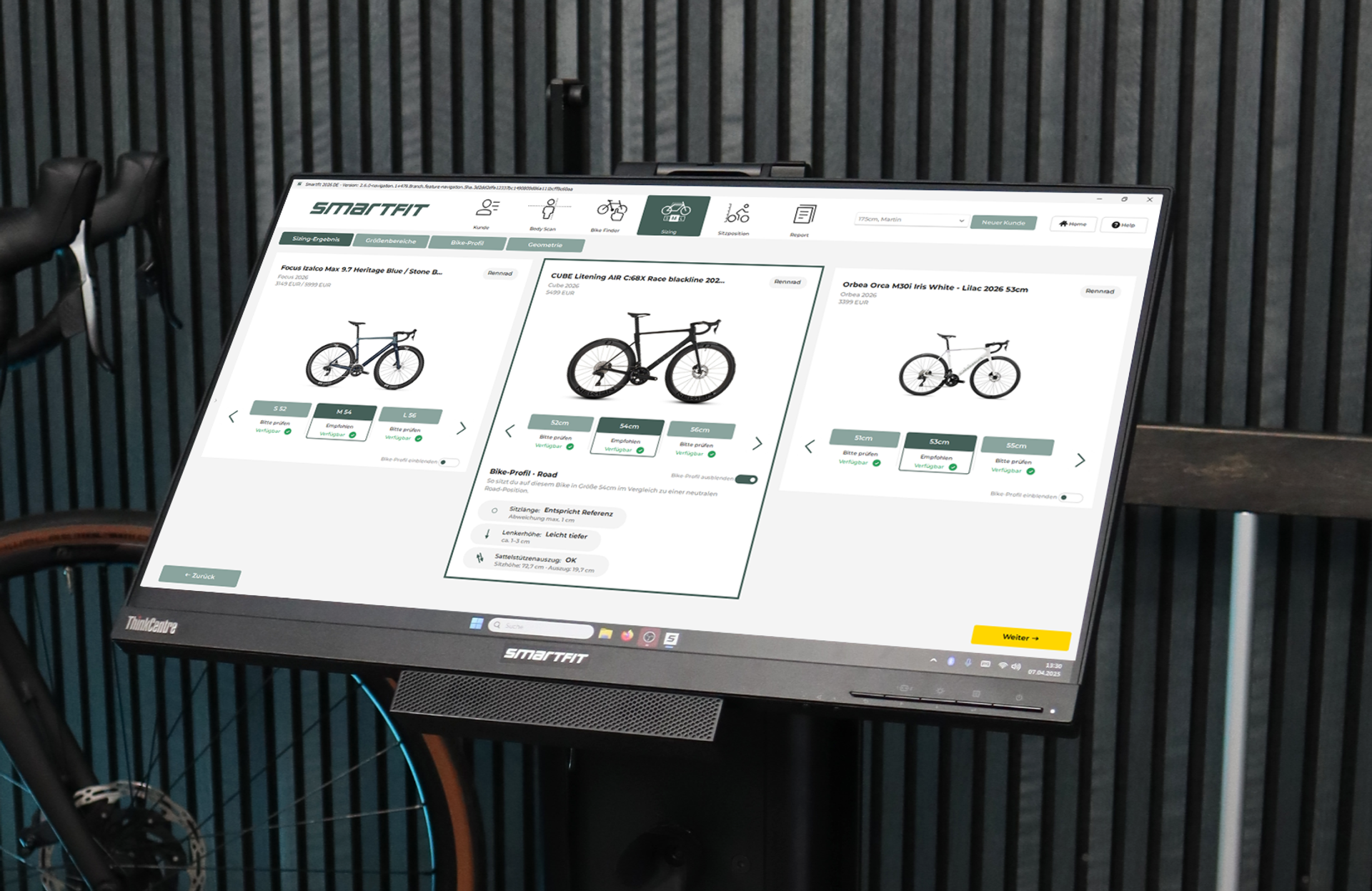
With Smartfit Software 3.0, Smartfit is taking digital sales consulting in the bicycle retail industry to a whole new level. Sizing, bike selection, riding position, and ergonomics now work together even more seamlessly—without any interruptions, redundant explanations, or unnecessary complexity. The result is a system that makes consulting not only more precise, but above all more efficient and easier to understand.
This is often where the biggest challenge lies in day-to-day sales: information is available, but it’s scattered—in the salesperson’s head, across separate tools, or throughout different stages of the consultation. To customers, this process can quickly seem complex or hard to grasp. Modern digital consulting must therefore do more than just provide precise data. It must structure conversations, highlight connections, and facilitate decisions—for both sides. This is precisely the goal of the new Smartfit Software 3.0.
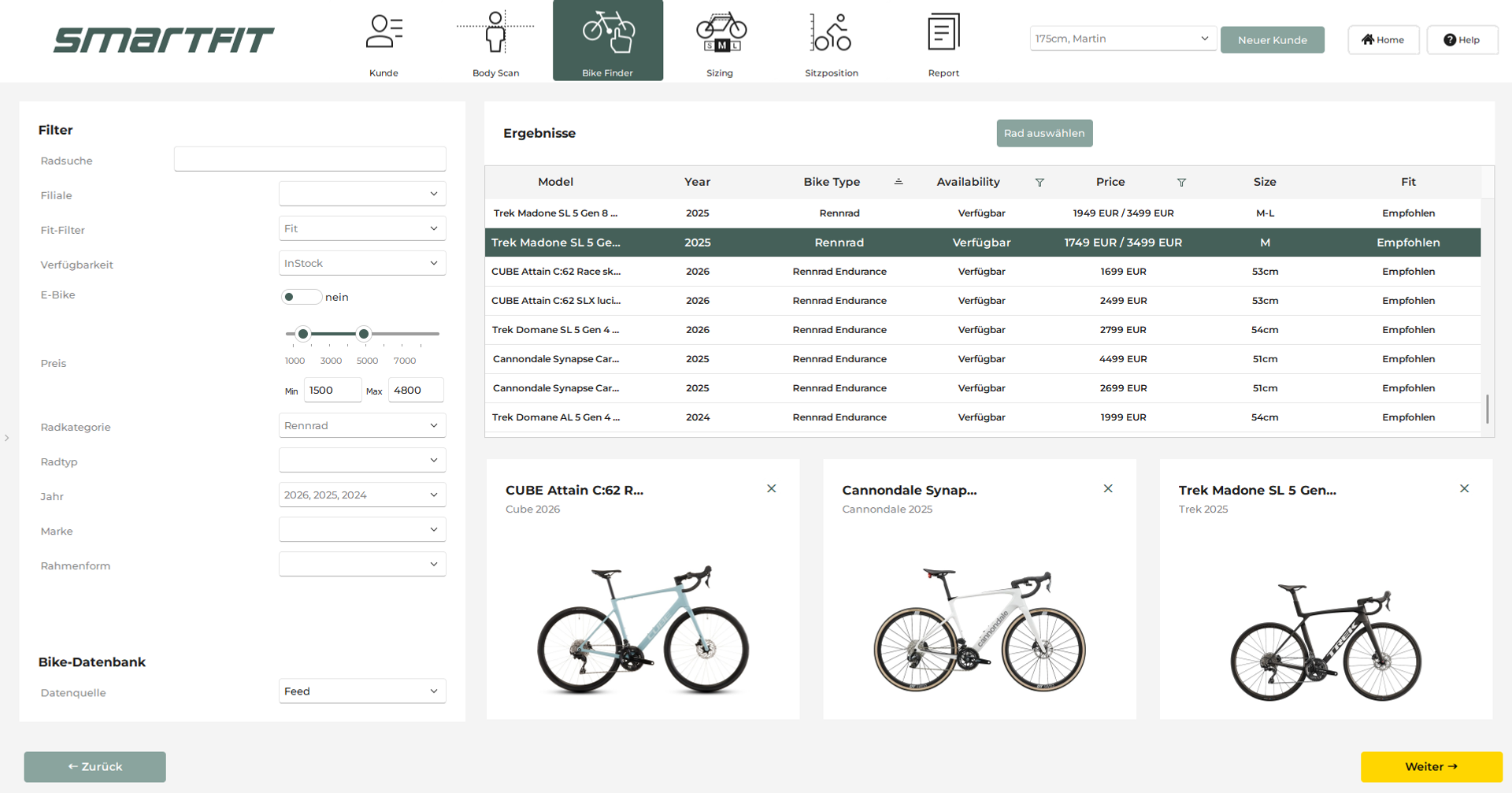
1. Bike Finder: From body measurements straight to available bikes
This is where the first key innovation of Smartfit Software 3.0 comes into play: the integrated Bike Finder with a direct link to inventory. Consultation, sizing, and availability are no longer treated separately but are combined into a single workflow. An abstract size recommendation thus immediately yields a selection of specific bikes that are actually available in the right size—clearly filterable by category, intended use, or price.
The previously standard process is thus consistently reimagined: Instead of first selecting a desired bike on the sales floor and then checking for the right size, the consultation begins with the appropriate size and then leads to the models actually available in the store. This shortens the path to a decision, lightens the load on the sales conversation, and makes the consultation noticeably more efficient.
Key Benefits:
- Automatic filtering of bikes that are actually available
- Shorter consultation time
- Greater clarity for customers
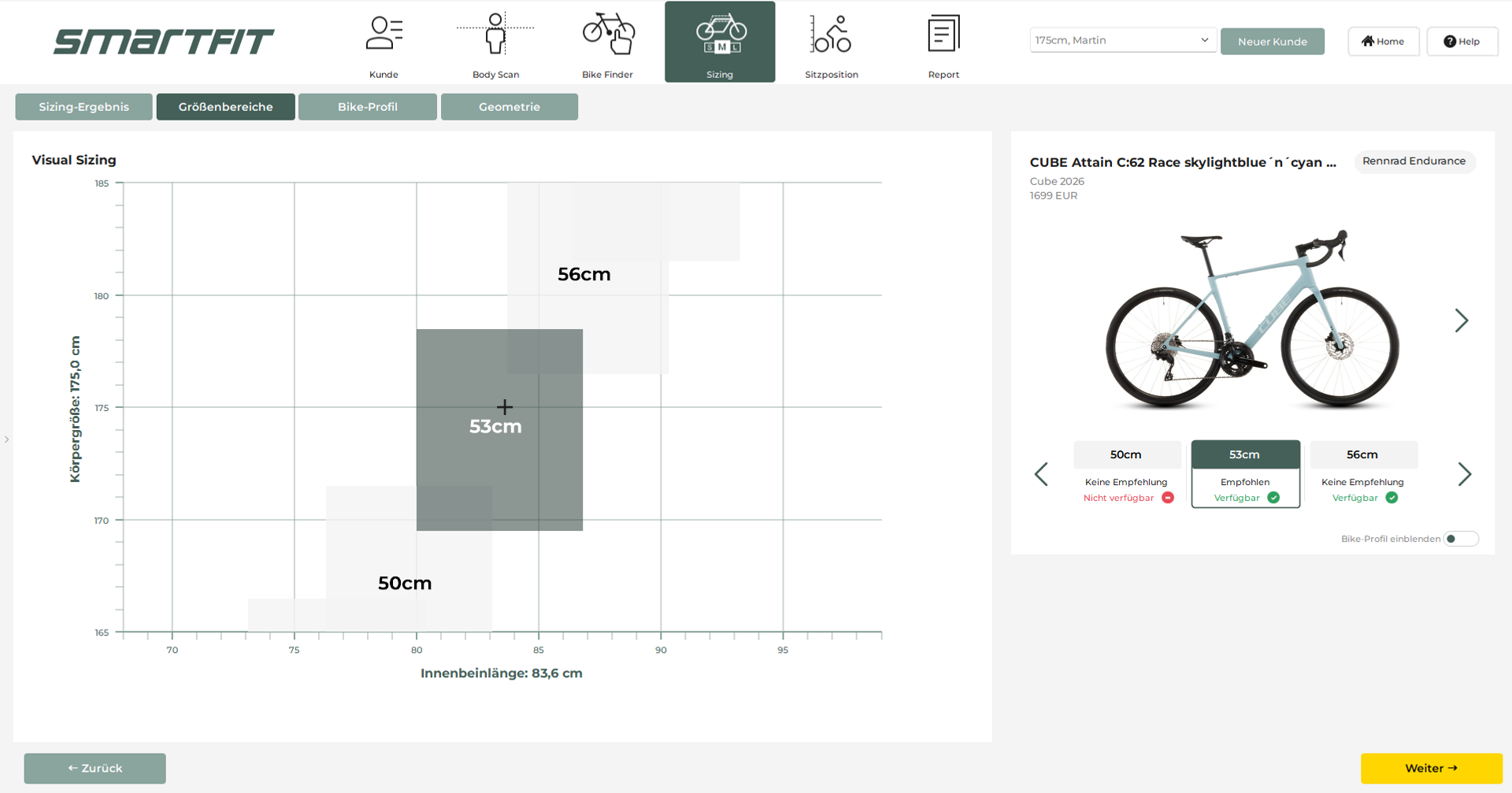
2. Sizing: Size ranges instead of rigid recommendations
The next iteration of Smartfit Software 3.0 builds consistently on this new logic. Sizing itself is no longer viewed as a fixed outcome, but rather as a transparent decision-making framework. Instead of a single, seemingly definitive size, the software visually displays for the first time where a customer falls within a defined size range. This allows retailers to immediately see whether someone falls in the middle of a size range or is closer to the edge—and whether a neighboring size is a realistic option.
The recommendation remains clear: a primary size is clearly marked, while additional alternatives are deliberately presented as options rather than deviations. This creates transparency during the conversation and provides reassurance to both retailers and customers. At the same time, it allows sufficient flexibility to accommodate personal preferences, different model geometries, or desired seating positions without running the risk of making the wrong purchase due to sizes that are too small or unrealistic.
Advantages of this approach:
- Greater transparency and confidence when choosing a size
- Recommendations are based on clarity rather than rigid numerical values
- Improved customer experience
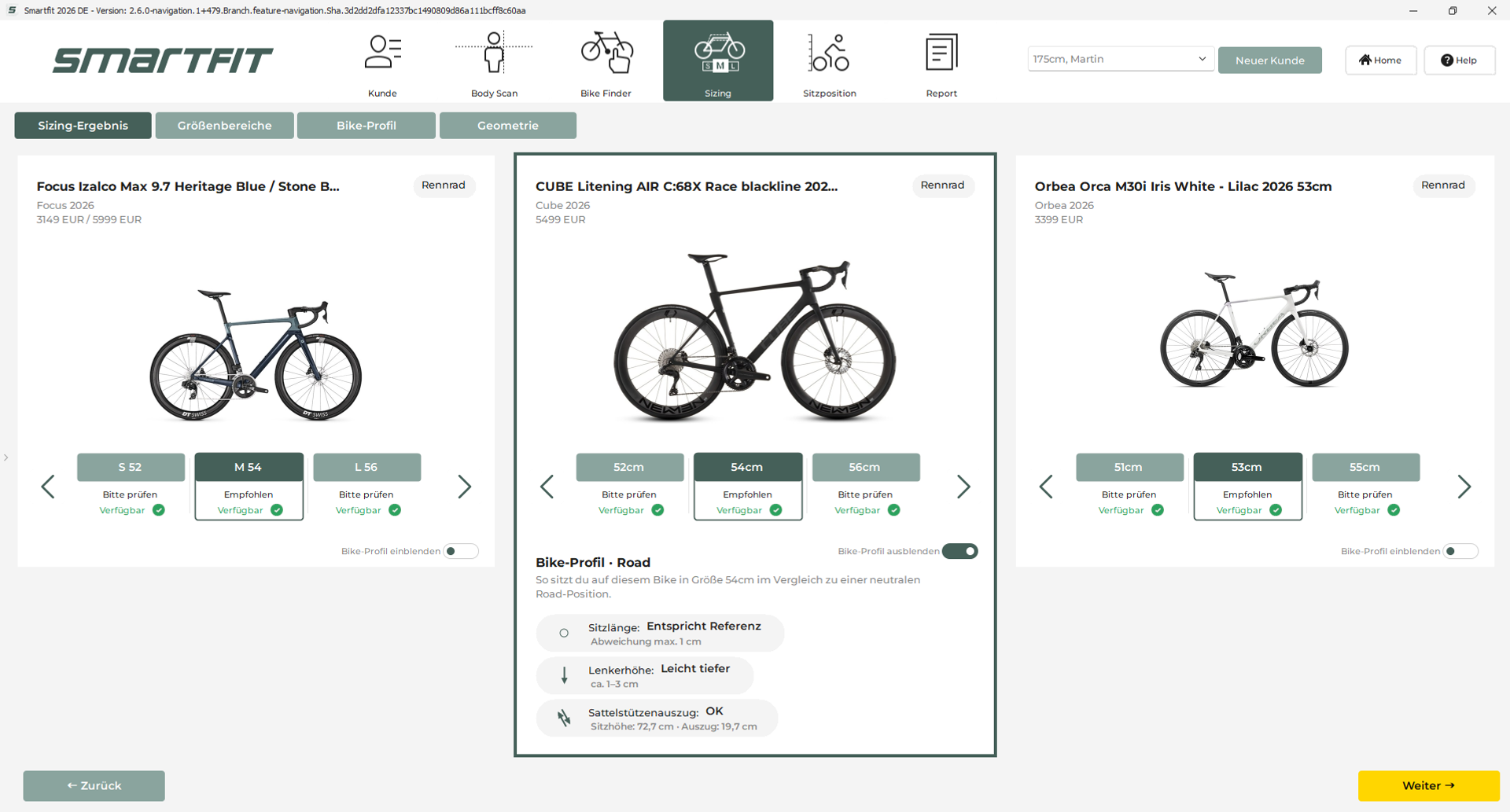
3. Bike Profile: Clear Descriptions Instead of Abstract Values
Alongside this new approach to sizing, Smartfit Software 3.0 also changes the way bikes are described and categorized. The revised bike profile deliberately avoids numerical scores or implicit ratings, relying instead on a qualitative, verbal description of the riding position. Comprehensible gradations are combined along the two axes of length and height—such as “slightly compact,” “moderately low,” or “significantly stretched.”
This provides clear added value for the sales conversation: instead of having to explain numbers, salespeople can immediately describe how a bike feels compared to the customer’s personal reference point. The assessment remains neutral—it’s not about good or bad, but about sportier or more comfortable. The bike profile thus shifts from being an analytical tool to an active conversation starter, making it easier to realistically compare different models.
The benefits:
- Stronger customer loyalty through clear communication
- Faster orientation during consultations
4. Fit Assistant: From Analysis to Interactive Setup
While the bike profile explains a bike’s characteristics, the Fit Assistant takes it a step further by bringing the specific riding position into play. The customer’s position on a selected bike is visually displayed—including deviations in length and height for personal reference. Changes to the stem, spacers, or handlebars can be simulated directly in the virtual cockpit, while the software automatically recalculates the effects of each adjustment.
Based on this, the system also suggests practical setups—such as a slightly more comfortable or sportier configuration. Dealers don’t have to think in terms of millimeters; instead, they can work with customers to try out and evaluate different options. The Fit Assistant thus allows customers to experience the seating position in real time for the first time and supports informed decisions—without unnecessarily complicating the sales conversation.
Highlights:
- Interactive Seating Position Simulation
- Automatic Recommendations
- Intuitive Visualization for Dealers and Customers
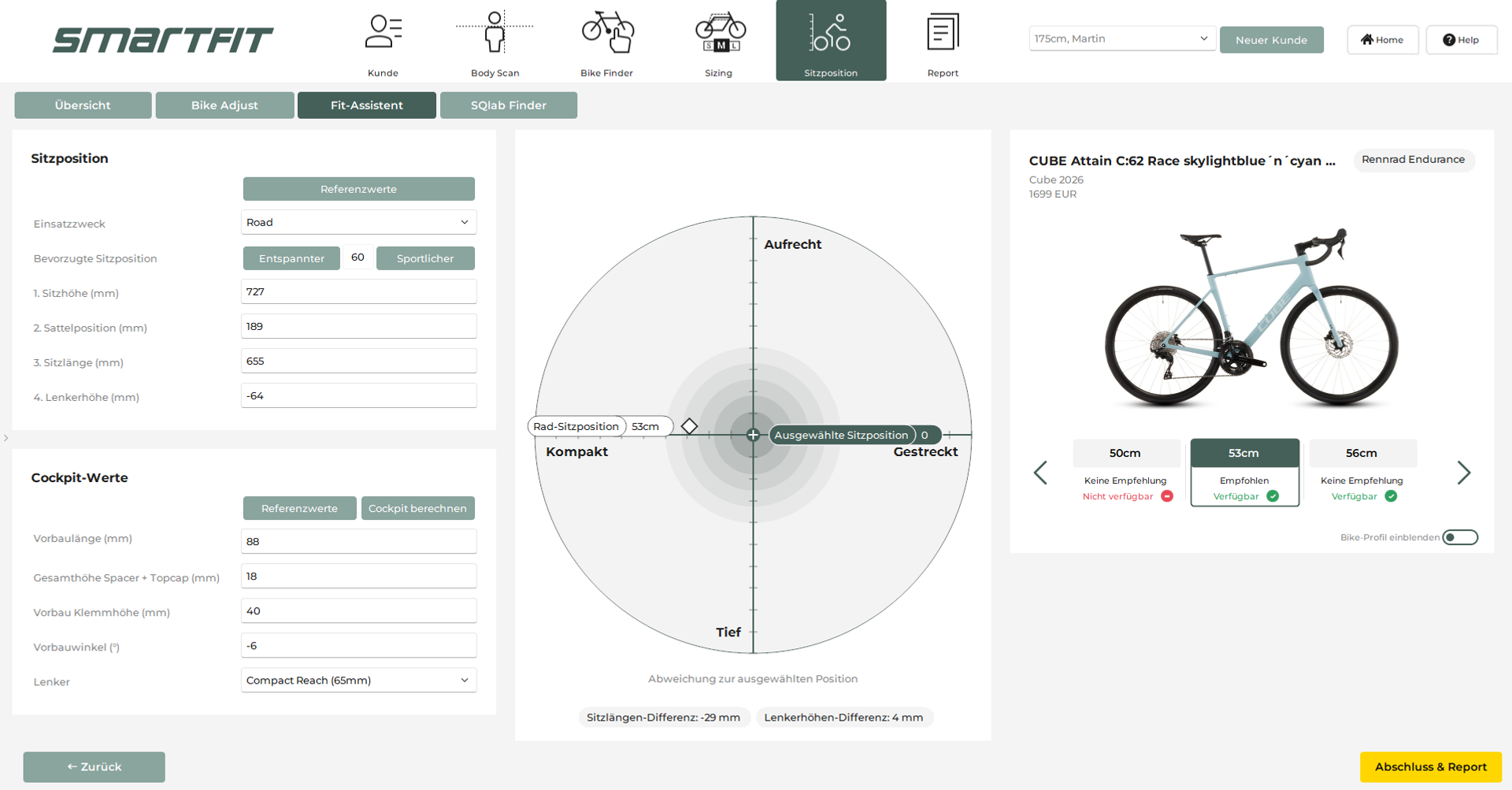
5. Clear Navigation: Structure for beginners, depth for experts
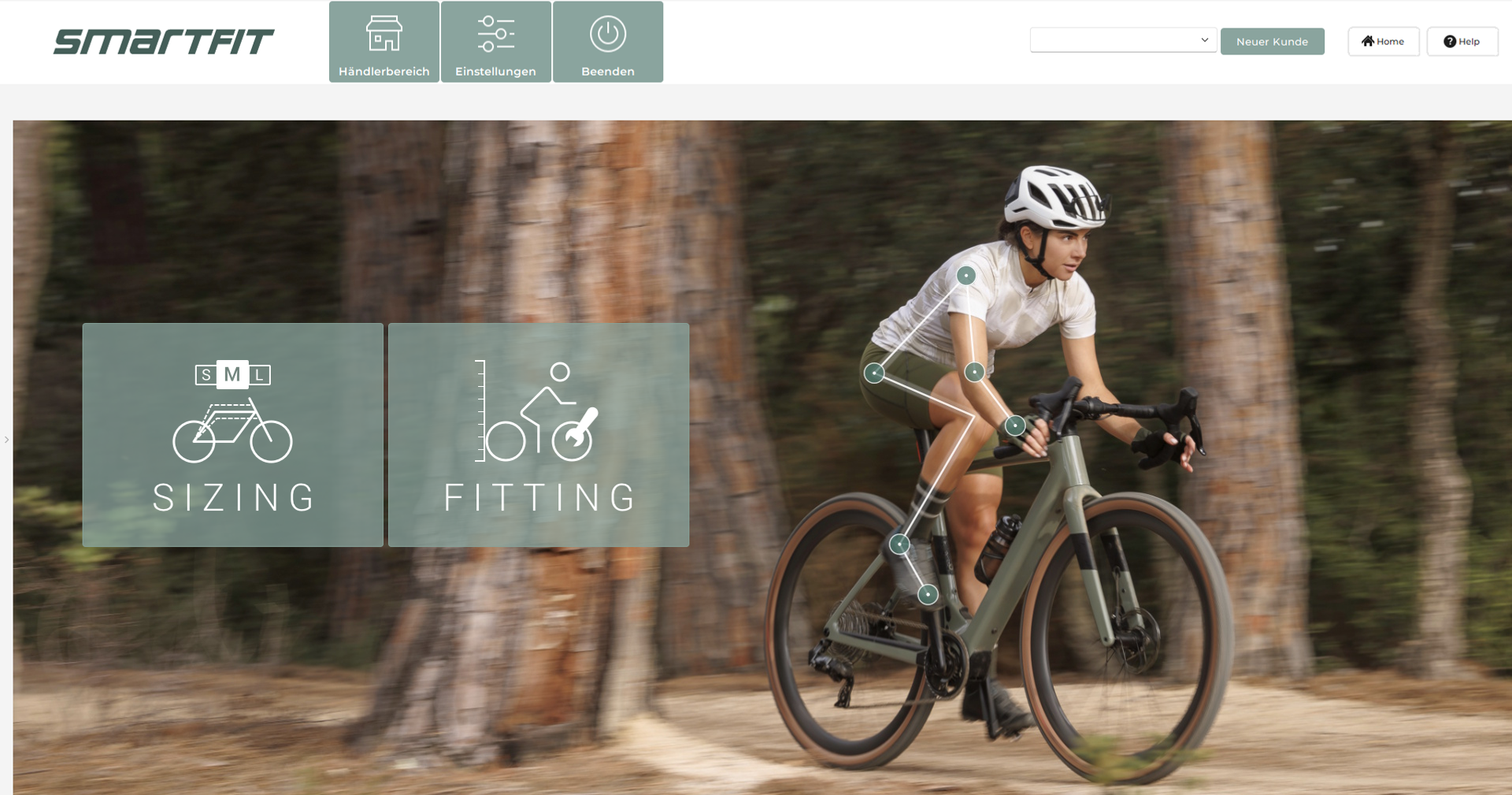
With its new main navigation, Smartfit Software 3.0 specifically addresses the growing complexity of modern bike fitting. The entire process is clearly divided into sequential steps: Find a bike, determine the right size, and fine-tune the riding position. For less experienced users, the software functions as a guided assistant that leads them confidently through the fitting process without overwhelming them with technical details or jargon.
At the same time, the full depth of the information is preserved. When it comes to sizing and riding position, users can deliberately “drill down” into detailed levels to discuss geometry, fit specifications, or cockpit configurations in detail. Retailers decide for themselves how deeply they want to delve into the subject matter—tailored to their own expertise and the needs of their customers. This keeps the interface intuitive without limiting professional advice.
At a glance:
- Guided consultation process for beginners
- More detailed options for experienced users
- Intuitive interface
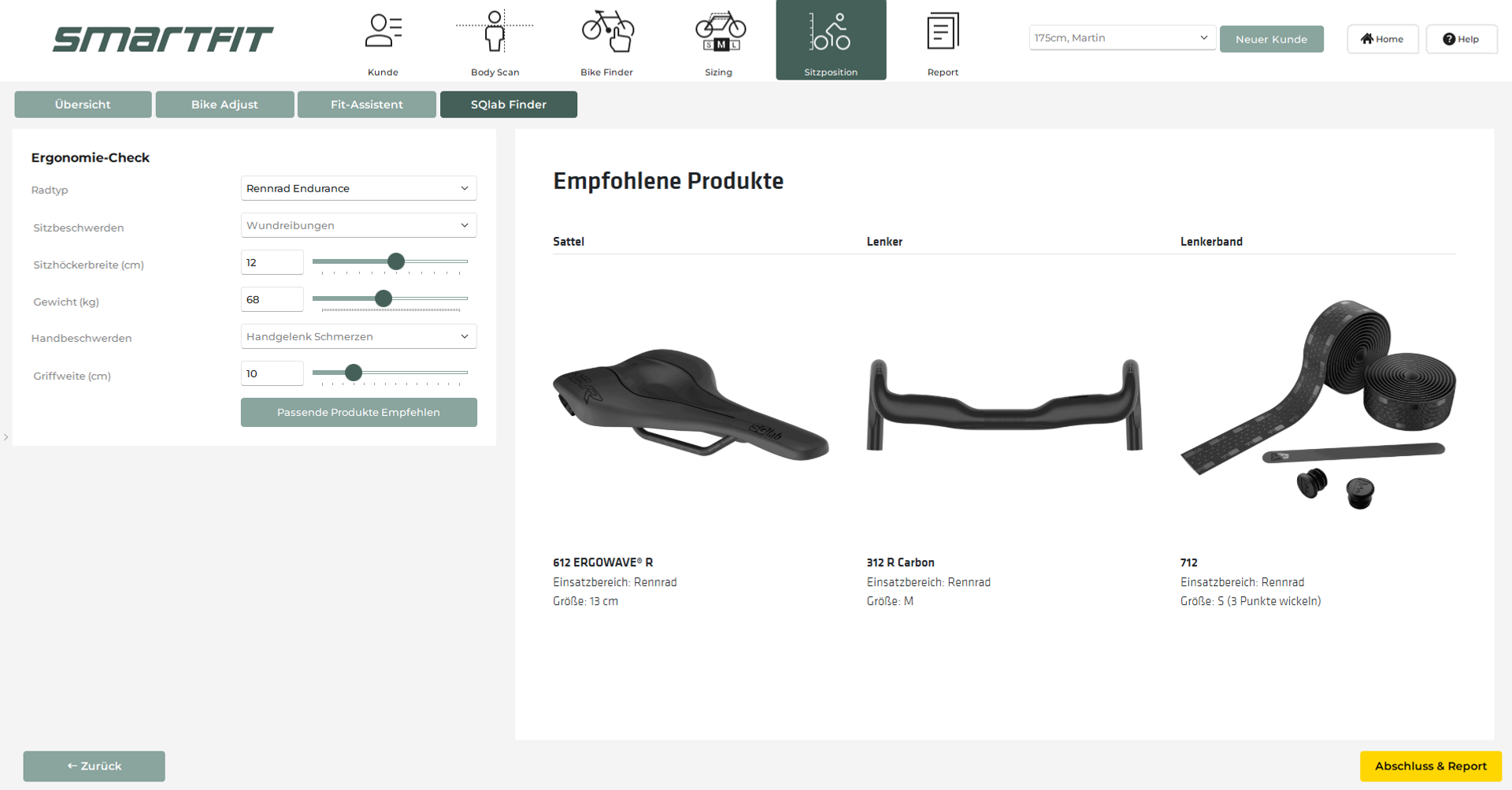
6. SQlab-Integration: From frame sizing to contact point consultation
With the integration of SQlab, Smartfit Software 3.0 completes the sales consultation process. What begins with determining the right frame size can be seamlessly continued through to personalized contact point recommendations. Once the bike and size have been selected, the process moves directly on to the saddle, grips, and handlebars—without switching tools or re-entering data.
Relevant basic information such as gender, intended use, or e-bike usage is automatically carried over from the sizing process and directly incorporated into the SQlab recommendation. For retailers, this creates a seamless consultation process in which bike purchase and ergonomics are naturally intertwined. Advice on accessories is not an afterthought, but a logical component of a comprehensive sales consultation.
Benefits for retailers:
- Comprehensive advice on everything from bikes to accessories
- Higher conversion rates through complementary recommendations
- Fewer returns thanks to tailored solutions
Conclusion: Smart guidance meets user-friendliness
Ultimately, Smartfit Software 3.0 brings us back to where good bike consulting begins: a structured, clear dialogue. Instead of isolated individual steps, the software integrates body measurements, bike selection, seating position, and ergonomics into a seamless consultation process. Information is not only recorded precisely, but also organized meaningfully and evaluated collaboratively. This results in advice that provides guidance, facilitates decisions, and builds trust—for customers as well as for retailers.