End of Season in Bike Retail: How Sizing Helps You Sell Remaining Stock
Learn how precise sizing helps you match customers with the right remaining stock at the end of the season.

Thomas Hahn
 AI-generated
What you’ll learn in this article
- Why the same sizes are almost always left over at the end of the season
- How brand-independent sizing helps you find new customers for remaining stock
- How to make sure an alternative recommendation doesn’t feel like a consolation sale
- Where fine-tuning with stem, spacers and saddle position is realistic, and where it isn’t
- Why returns hurt especially on discounted bikes
Mid-October, just before closing. Fourteen bikes from the outgoing model year are still on the sales floor, and a dozen of them are in sizes S and XL. The problem: over the past few weeks, customers have mostly asked for M and L. In this situation, the reflex is often the same: take another five percent off and hope the last few bikes eventually sell.
But this is exactly where it pays to look at your stock differently. Not every size that seems hard to sell actually is. Sometimes it’s simply being offered to the wrong customers. So the key question isn’t “How do I still get this XL sold?” Instead, ask yourself: “Who is this XL actually the right size for?” That’s exactly where precise sizing comes in.
Before You Offer the Next Discount, Measure
When you look at what typically gets left over at the end of a season, it’s often the sizes at the extremes, niche colors, and special spec variants. The reason is simple: for many models, the middle of the size range sells first. It fits a larger share of customers, which makes it easier to plan for when ordering and easier to sell later.
What’s left standing is whatever looks, at first glance, like it only fits a smaller group. But that first glance is often based on a manufacturer’s size chart, which mostly goes by body height. If the chart says you’re an M, you look for an M, and S or L drop out of the picture right away.
 AI-generated
In practice, the line is often less clear-cut. Depending on body proportions, geometry and preferred riding position, two neighboring sizes can easily work for the same person. But you only find out how much room there really is when you measure objectively instead of estimating.
A rule of thumb: the coarser a model’s size range is, for example with bikes offered in only three or four sizes, the more often customers fall between two sizes. That’s exactly where you gain extra room for your clearance sales.
Your customer wants an M. Your stock needs someone for an L.
The second lever is to stop looking at sizes in isolation within a single brand. An M isn’t automatically an M. Frame sizes can only be compared to a limited extent between manufacturers, and even between different model lines from the same brand.
What matters more are values like stack (the vertical distance from the bottom bracket to the top of the head tube) and reach (the horizontal distance from the bottom bracket to the top of the head tube). They describe much more precisely how tall and long a bike really is. That’s why last year’s endurance road bike in size L can fit the same person as a current aero model in M.
For your clearance sales, that’s exactly what makes this interesting. If you only think within each brand’s size chart, you may be ruling out bikes that would work very well for your customers. Our tip: the Smartfit In-Store Solutions measure consumers in just a few steps and calculate suitable sizes regardless of model or brand. In the best case, “We don’t have that model in M anymore” no longer ends the sale. Instead, it becomes a new option: “We still have an L here that fits your measurements very well based on its geometry.”
How to Recommend the Size You Have in Stock Without Sugarcoating It
This is exactly the point where it’s decided whether an alternative size comes across as good advice or as an attempt to get rid of the last of your stock at any cost. If you reach for the next size up or down without a clear reason, it quickly feels like a consolation sale. An objective measurement changes the argument: you’re not recommending the size because it happens to still be in the back, but because the customer’s measurements, proportions and intended use point to it.
 AI-generated
In concrete terms, instead of “We only have this model in L,” you explain where the customer falls within the size range and what the choice means for their riding position. A larger size, for example, might feel a bit more upright and stable, while a smaller one tends to be sportier and more agile. When you tie those differences to the customer’s riding style and measurements, a leftover size becomes a recommendation that makes sense.
Important: A sizing system is not a tool for talking people into bikes that don’t fit. If a size doesn’t work, it shouldn’t be sold. This limit is exactly what makes objective size advice credible. The line is drawn where fine-tuning turns into compensation. If you have to make up a significant size difference with extreme stem lengths or saddle positions, the bike is simply the wrong one. A good sizing system widens your room to maneuver, but it can’t stretch anatomical and geometric limits.
When a Size Gives You Room to Work With, and When It Doesn’t
Modern sizing systems therefore don’t work with just a single recommended size, but with size ranges. Smartfit Software 3.0, for example, shows where a person falls within a frame size: closer to the middle, or already at the upper or lower end.
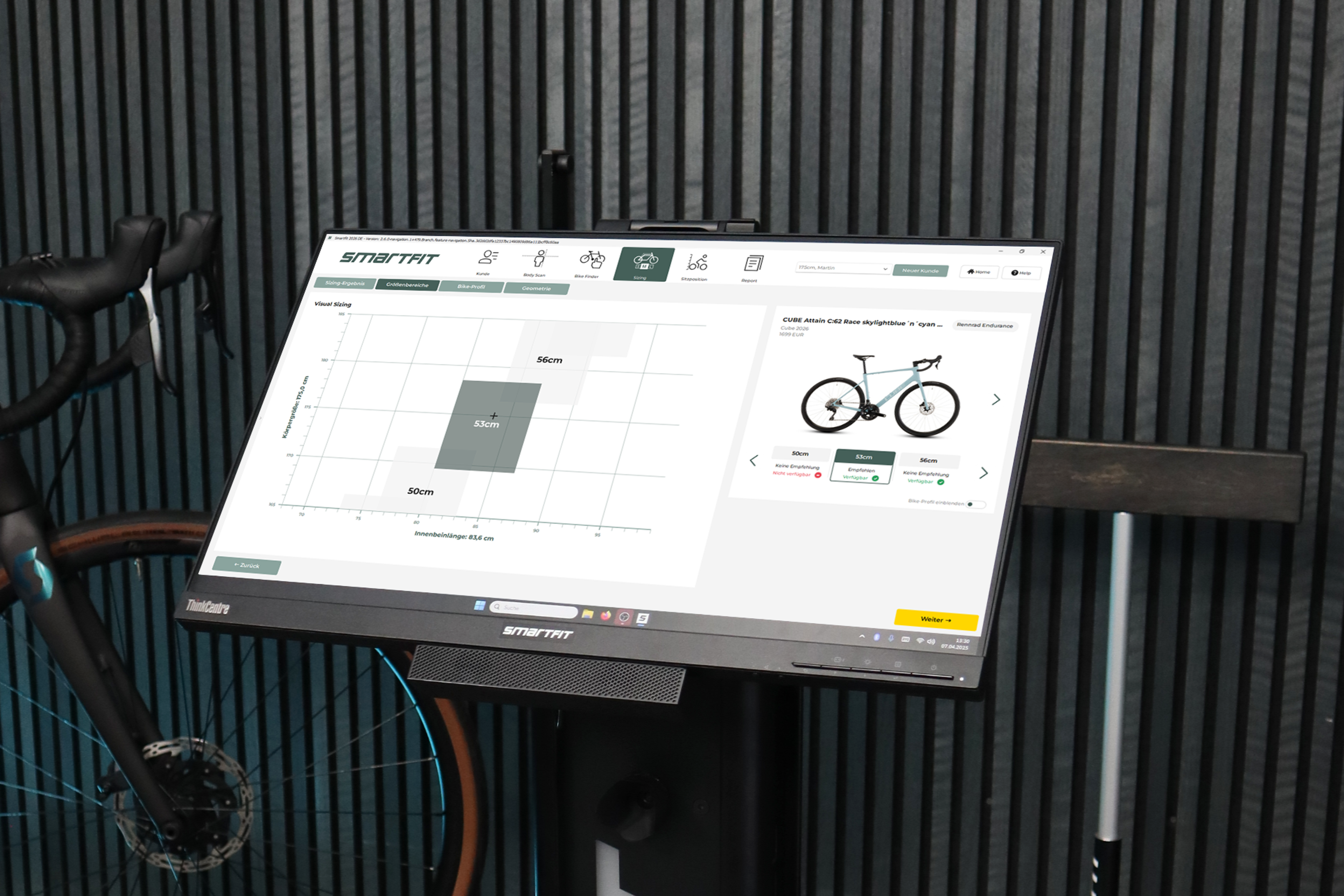
This is the sale-relevant part: this information is decisive for clearance. Someone in the middle of an L doesn’t suddenly become an ideal candidate for an XL just because you fit a shorter stem. Someone at the upper end of L, or the lower end of XL, can sit very well on either size, depending on the riding position and handling they want. For fine-tuning, you then have the usual options: changing the stem length, spacers, saddle position or handlebar width.
The numbers are worth a closer look, too. On an e-bike priced at €4,500, an extra five percent discount means €225 less in sale price. A different stem and a bit of extra consulting time can be considerably cheaper, and in the best case they even give the customer the better solution.
Online: Remaining Sizes Need Guidance, Not Just Percentages
Online, the problem gets worse because there’s no consultative sales conversation. Sale pages are often full of percent signs but give little guidance on whether the remaining sizes actually fit. Customers are then often left with two options: abandon the purchase or order on a hunch. Neither is attractive for retailers. Especially with items that are already discounted, returns hurt the most, because the margin is already reduced and logistics, staffing and reconditioning costs come on top.
The bike brand Waldbike, for example, puts the cost of a single bike return at a minimum of €300. An integrated Smartfit Sizing Widget directly on the product page can therefore be especially relevant during clearance. Customers enter a few body measurements and see right away whether a size that’s still available works for them.
It works both ways: the widget prevents bad purchases, but it can also surface sizes that interested shoppers might never have clicked on based on a traditional size chart.
Measure First, then Discount

So before you cut the price again at the end of the season, there’s a better first step: take a closer look at who your remaining bikes actually fit. Not every size that seems hard to sell needs a bigger discount. Sometimes it simply needs the right customer. Our call to action: make sizing a fixed part of your clearance strategy. Measure systematically, think across brands, and use the room that geometry and fine-tuning actually give you. That way, you don’t sell remaining stock at any price, but with a recommendation that makes sense, and you protect both your margin and your customers’ trust.